BOFA works to fulfil Vision 2032 before the clock runs out

  • -

    year

  • -

    d

  • -

    t

  • -

    m

  • -

    s

All questions and answers

BOFA takes the waste. But where do I hand in my used tyres? Can they have rims on them? What do I do with the half a can of paint that was left over?

We have collected the most frequently asked questions here. Click and see the answer.

At the bottom of the page, we have a direct email to BOFA's waste experts if you can't find the answer on the page.

Frequently asked questions

  • My bin is only half emptied. Why, and what do I do?

    We are unfortunately experiencing that a few households are having issues with waste in their bins after they have been emptied. We apologise for the inconvenience and are actively investigating how to best resolve the problem.

    There can be various reasons why your rubbish is stuck in the bin:

    • Plastic and mixed waste can be difficult to remove from the bin if it's compacted too tightly. Tip! Avoid overfilling your bin.
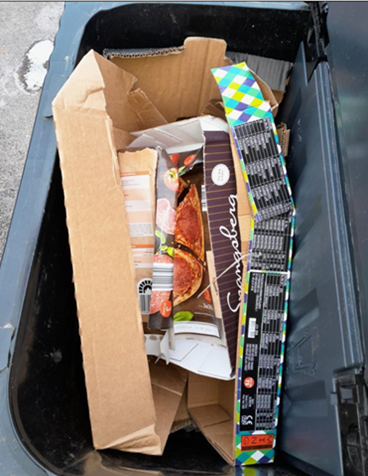
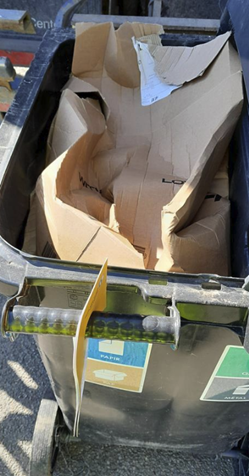
    • The waste can get stuck, for example, if there are large pieces of cardboard in the bin. Your bin is only intended for smaller pieces of cardboard – no larger than A4 size, such as toothpaste boxes, cereal boxes, or other cardboard packaging.
    • The waste may be frozen solid. Frost can unfortunately mean that some waste freezes solid in the container if it is damp or wet. Tip! Try to keep the container dry as much as possible.
    • The soft plastic can become electrostatically charged due to frost. The low temperature can cause the soft plastic to ‘stick’ to the side of the container and therefore be more difficult to get out.
    • Certain items of waste can block the rest of the waste from being expelled, for example, by hitting the edge of the container.

    New settings on the bin lorry

    Often the challenge is due to the refuse collection vehicles having new settings that are gentler on our equipment.

    This means, among other things, that compressed and/or frozen waste, as well as larger pieces of cardboard, may have difficulty releasing from the container, meaning it may not be emptied completely. The refuse collector is not allowed to manually loosen waste that is stuck in the bin, as this can pose a health risk to them.

    If there is rubbish left in the bin, the refuse collector will take a photograph of it. This way, BOFA gets an overview of the problem and its extent.

    BOFA is working diligently to find a workable solution and is in dialogue with the container supplier, the vehicle bodybuilder, and Meldgaard.

    “I haven't emptied my bin completely, what do I do with the rubbish?”

    Unfortunately, it is not possible to send the garbage truck back to your address, as the refuse collector has already been by and attempted to empty your bin. If you are short of space, you have the following options:

    Residual waste and recyclable waste

    You can always drop off your residual waste and recyclables (plastic, multi-layer packaging, cardboard/paper, glass, and metal) at the recycling centre. Find your nearest recycling centre. here.

    Bulky waste

    Plastic, metal and large cardboard can also be left out for bulky waste collection. You can read more about the bulky waste scheme by clicking here.

    Examples of compacted cardboard causing problems with emptying the container.

  • What's happening with Precious Metal

    Send to H. J. Hansen Recycling in Odense, where it is sorted into metal types and melted down for recycling.

  • What happens with ceramic glass

    Send together with Sanitary & Porcelain to Norrecco in Copenhagen, where it is reused in e.g. large concrete "Lego" bricks for cubicle partitioning.

  • What's happening with TV & monitors

    The fraction is covered by producer responsibility legislation. BOFA is therefore only responsible for the collection and short-term storage of the fraction. The producer, or company (Elretur, H. J. Hansen) hired by the manufacturer is responsible for the reuse, recycling, recovery or disposal of the fraction after collection/storage.

  • What happens with Municipal Waste (often confidential)

    E.g. confiscated drugs/plants, confiscated contraband, invasive plants, destruction of dead animals with zoonotic diseases (which can spread between animals and humans). Delivered directly to the energy plant's waste hopper and utilised. There is no further risk of human contact with the municipal waste.

  • What happens with windows

    Collected at recycling centres and stored before being sent to RGS Nordic in Herlufmagle, where some of the materials are recycled, such as wood and glass. What cannot be recycled is recovered through incineration or landfill.

  • What happens with heavy metal/chemical contaminated soil and sweeping waste

    Received at BOFA in Rønne and deposited.

  • What happens with tree impacts over 80 cm in diameter

    Collected at recycling centres and via BOFAs weight. Shredded and composted in Rønne. The sieve residue (which is the part that was not sufficiently composted, e.g. larger branches) is used for incineration.

  • What's happening with Wood for recycling

    Collected at recycling centres and collected in Rønne. Shredded and sent to Kronospan in Jutland, where it is recycled into new chipboard.

  • What's happening with Large Electronics

    The fraction is covered by producer responsibility legislation. BOFA is therefore only responsible for the collection and short-term storage of the fraction. The producer, or company (Elretur, H. J. Hansen) hired by the manufacturer is responsible for the reuse, recycling, recovery or disposal of the fraction after collection/storage.

  • What's happening with Stone & Gravel

    Collected at recycling centres and transported to a reception facility in Rønne, where it is broken down and sold as a recycling stable (stable base for surfaces such as roads, paths and driveways).

  • What happens to waste oil delivered in a tanker

    Collected at the hazardous waste transfer station in Rønne and then sent to Avista Oilwhich cleans/refines the oil and reuses it for new oil products.